
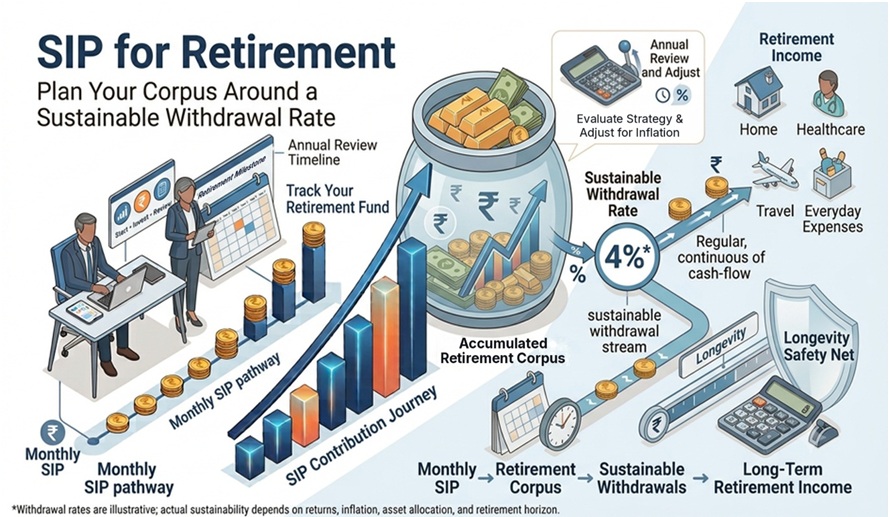
Retirement planning is often reduced to one question: How much should I invest every month? While the monthly SIP amount matters, it is only one part of the equation. A more useful approach is to work backwards from your expected retirement expenses, estimate the corpus required, and then determine a sustainable withdrawal rate.
This makes SIP for retirement less about accumulating the biggest possible number and more about creating a corpus that can support your lifestyle for decades after your regular income stops.
Start With Your Retirement Income Requirement
The first step is to estimate how much you may need during retirement. Your current monthly expenses provide a starting point, but they should not simply be multiplied by 12.Consider how your expenses could change after retirement. Some costs, such as commuting or work-related expenses, may fall, while healthcare, travel or leisure expenses could increase.
Inflation is equally important. If your current monthly retirement-equivalent expense is ₹60,000, it will not have the same purchasing power 20 or 25 years from now.For example, assuming 6% annual inflation, ₹60,000 today would become roughly ₹1.93 lakh in 20 years. Therefore, retirement planning needs to account for the future value of expenses rather than today’s spending alone.
Corpus Is Only Half the Plan
Suppose you build a retirement corpus of ₹2 crore. Is that enough?
There is no universal answer because the sustainability of that corpus depends on how much you withdraw from it, the investment returns you earn, inflation, taxes and the length of retirement.This is where withdrawal rate planning becomes important.
A withdrawal rate is the percentage of your retirement corpus that you withdraw during the first year of retirement, with subsequent withdrawals generally adjusted for inflation depending on the strategy.For instance, withdrawing ₹8 lakh from a ₹2 crore corpus represents a 4% initial withdrawal rate.A lower withdrawal rate generally provides a larger margin against market volatility and longevity risk, although the appropriate rate depends on the individual’s circumstances and portfolio.
Why Withdrawal Rate Matters
Imagine two people retire with ₹2 crore each.Person A plans to withdraw ₹15 lakh in the first year, while Person B plans to withdraw ₹7 lakh. Both have the same corpus, but their sustainability requirements are very different.
The sequence of market returns can also affect outcomes. A significant market decline early in retirement, combined with large withdrawals, can put greater pressure on the remaining portfolio.
Therefore, instead of asking only, “How large should my retirement corpus be?”, ask:“What level of annual retirement spending can my corpus reasonably support?”
Then Work Backwards to Your SIP
Once you have estimated your future retirement expenses and a target corpus, you can calculate the SIP required to reach that goal. A sip calculator can help estimate the monthly investment needed based on your investment period, target corpus and assumed rate of return. However, the calculation should not be treated as a guaranteed outcome. Mutual fund returns are market-linked, and actual returns can differ substantially from assumptions. It can therefore be more practical to review your SIP periodically and increase it as your income rises. A 5–10% annual SIP increase can potentially make a significant difference over a long investment horizon.
Build Flexibility Into the Plan
Retirement planning should not end once you reach your target corpus.As you approach retirement, review your asset allocation, expected expenses and withdrawal requirements. You may also maintain separate reserves for healthcare, emergencies and large one-time expenses rather than funding everything through regular portfolio withdrawals.
It is also useful to distinguish between essential and discretionary expenses. Essential expenses may require a more conservative funding approach, while travel or lifestyle spending can potentially be adjusted during periods of poor market performance.
Review the Plan, Not Just the SIP
A SIP for retirement is a disciplined way to accumulate wealth, but the SIP amount itself should not become the sole measure of whether you are on track.
Your retirement plan should connect three numbers: Future expenses → Required corpus → Sustainable withdrawal rate
As your salary, expenses, retirement age, family responsibilities and investment portfolio change, these numbers may need to be recalculated.The objective is not necessarily to build the largest possible corpus. It is to build a corpus that is appropriate for your expected lifestyle and can potentially support your income requirements throughout retirement.
Ultimately, retirement planning is a two-stage process: accumulate the corpus during your working years and manage withdrawals responsibly after retirement. Starting your SIP early gives compounding more time to work, while incorporating withdrawal-rate planning helps ensure that the corpus you build has a purpose beyond simply reaching a large number.
This article is for educational purposes only and should not be considered investment advice. Actual returns, inflation and retirement requirements can vary, and investors should evaluate their individual circumstances before making investment decisions.





Leave a Reply
You must be logged in to post a comment.